What domain privacy is and why it matters
Domain privacy keeps personal registrant details out of public records. Learn what it protects, why some TLDs do not allow it, and how Doory includes it where available.
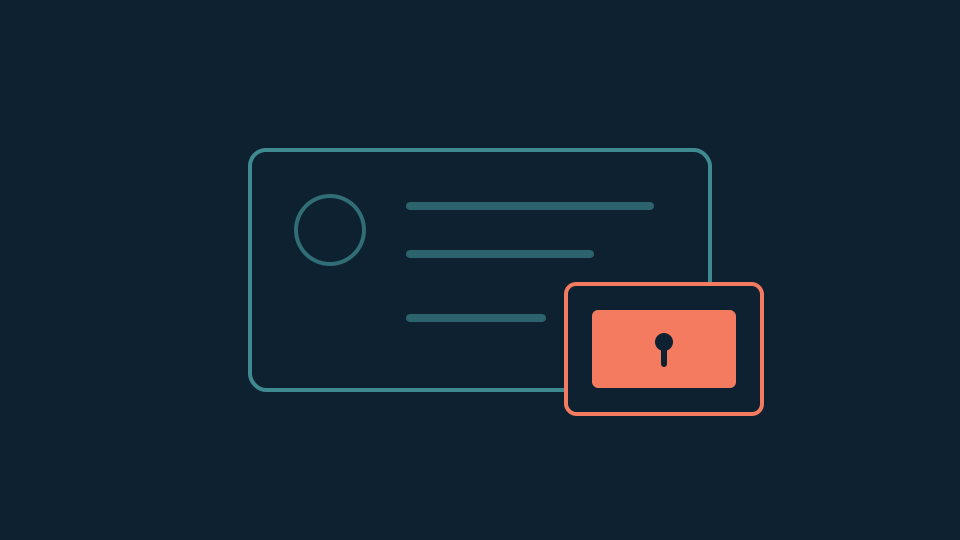
Registering a domain requires real contact information: a name, an address, an email, a phone number. Historically, much of that record was published for anyone to look up. Domain privacy—sometimes called WHOIS privacy or a proxy service—substitutes the registrant’s personal details with the privacy provider’s contact information in the public record, while the registrar still knows who actually holds the domain.
What the public record exposes
A public registration-data lookup can return the domain’s registrar, dates, nameservers, status codes, and—depending on policy—registrant contact fields. Privacy regulation has pushed many registries and registrars to redact personal data by default, so modern results are often partially hidden even without a privacy service. But redaction rules vary by registry, registrar, and registrant type, and they are policies, not guarantees. A privacy service makes the masking deliberate instead of incidental.
Why it matters
Published registrant details get harvested. The predictable results are spam to the registration email, misleading renewal notices designed to look like invoices, and cold calls that begin the moment a new domain appears. For a home-based business, the stakes are higher: the registered address may be a home address, published to the world for the life of the domain.
There is also a quieter risk. Public contact details give social engineers raw material—a real name and email tied to a real domain make a convincing pretext for phishing the business itself.
Privacy is not anonymity. The registrar and privacy provider know the actual registrant, and legal process, dispute policies, and law enforcement can still reach them. Domain privacy protects a business from the public internet, not from accountability.
Not every domain can have it
Privacy availability is a registry decision before it is a registrar feature. Some endings support proxy services routinely; others restrict or prohibit them—several country-code TLDs require public registrant data or exclude proxy registration entirely, and eligibility-based endings may require the record to show the qualifying registrant. The same business can hold one domain that supports privacy and another that never will.
That is why the honest phrasing is always conditional: privacy applies where the TLD, registry, and registrar support it, and the order flow shows the actual state for the specific name being registered.
How Doory handles it
Domains registered or transferred through Doory include privacy at no additional charge where it is available for that TLD. The domain search and portal checkout remain the authority for the specific name: they reflect whether privacy applies, and the final configuration is confirmed during the order. Where a registry does not permit privacy, no service can add it—the record follows the registry’s rules.
Deciding what you need
If the domain is tied to a person—a sole proprietor, a home office, a personal project—privacy is usually worth having wherever it is supported. If the business prefers a transparent public record, or operates under a TLD that requires one, a complete and accurate record serves better than a masked one. Either way, keep the underlying registrant details current: privacy hides the record from the public, but registrars still verify it, and stale contact data puts the domain itself at risk.
The useful conclusion
Domain privacy is a screen between your registration record and the public internet: valuable against harvesting and pretexting, powerless against legal process, and unavailable where a registry says so. Know which of your domains support it, let the checkout confirm what applies, and treat the qualifier—where available—as part of the answer, not fine print.
Related service:Search and manage domains.